
Doors Can Still Open After a Collision Cuts Power — GB 48001-2026 Takes Effect, Making Automotive-Grade Supercapacitors a Must-Have
In the event of a collision or fire, new energy vehicles may experience an instantaneous loss of power, causing electric door handles to become inoperative—leaving doors locked and hindering both escape and rescue efforts. A new mandatory national standard has now been introduced to address this hidden risk.
A Mandatory National Standard Addressing "Power-Loss Failure"
The mandatory national standard GB 48001-2026, *Safety Technical Requirements for Automotive Door Handles*, was released in January 2026 and will officially take effect on January 1, 2027. The standard is administered by the Ministry of Industry and Information Technology and was co-drafted by organizations including the China Automotive Technology and Research Center (CATARC), Geely, and Li Auto.
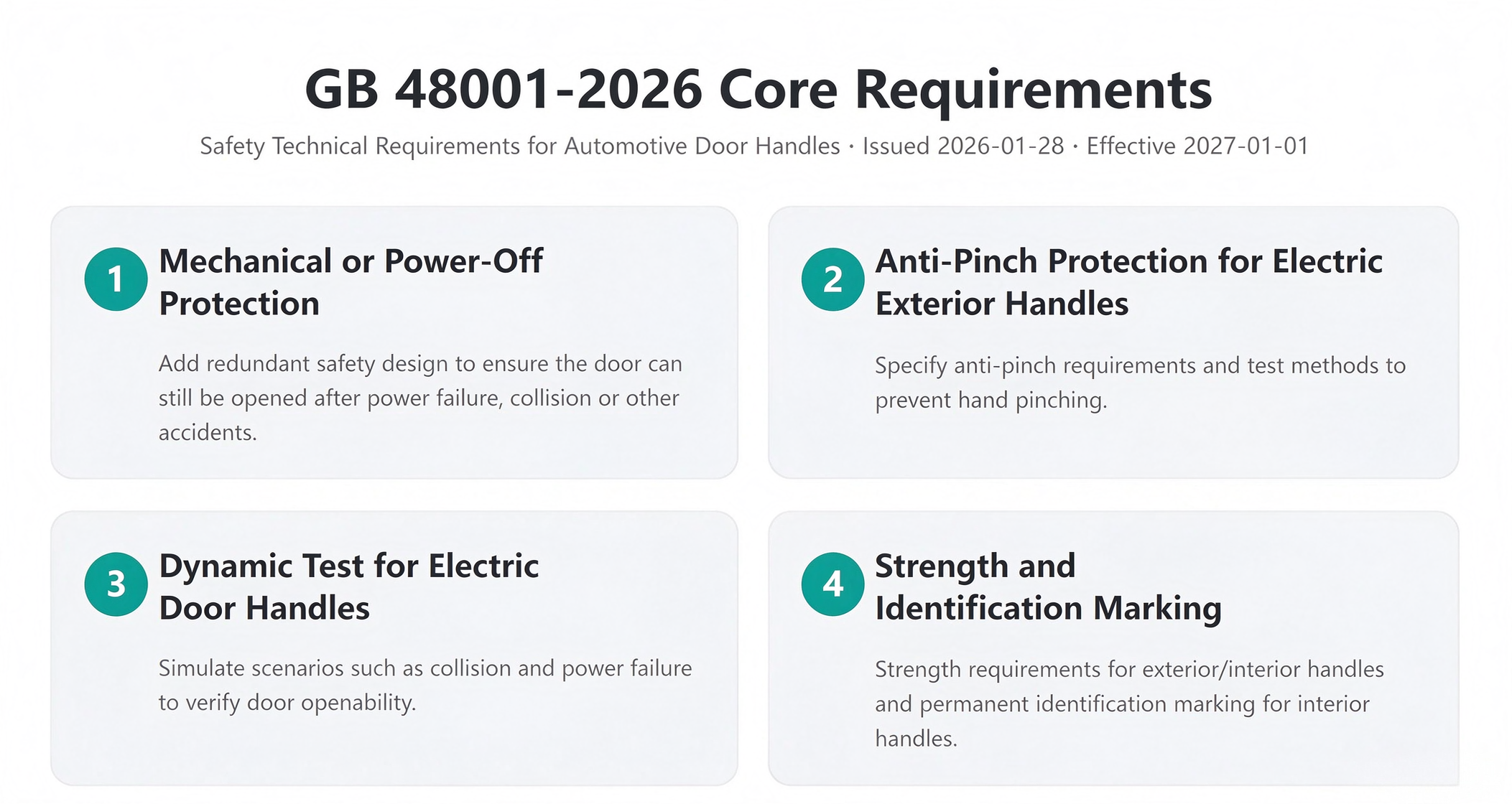
The pain points addressed by this standard are clear: existing vehicle door handles on the market suffer from issues such as insufficient structural strength, safety risks in control logic, difficulty in operation, failure during power loss, and the potential to trap fingers. In particular, during accidents like collisions or fires, a loss of vehicle power can render both electric exterior and interior door handles inoperable, significantly hindering escape and rescue efforts.
To address this, the standard mandates the inclusion of safety redundancy features—such as mechanical overrides or "power-loss protection"—to ensure that vehicle door systems can still be opened in the event of a power failure, collision, or similar emergency.
Specifically, the standard establishes requirements for anti-pinch functionality in electric exterior door handles, dynamic testing for electric door handles, structural strength for both exterior and interior handles, and the proper labeling and installation of flush-mounted (retractable) and emergency interior handles. Previously, domestic standards—such as QC/T 988-2014 (*Automotive Exterior Door Handles*) and QC/T 1211-2024 (*Passenger Vehicle Interior Door Handle Assemblies*)—focused exclusively on traditional mechanical handles. This new standard fills a critical gap by setting requirements for the layout, labeling, safety functions, and structural integrity of electric and flush-mounted door handles.
Key takeaway: Mechanical redundancy serves as the baseline, while "power-loss protection" acts as an additional safeguard for electric door handles. In the instant a collision causes a loss of vehicle power, this system provides an independent emergency power source to the door-lock actuator—a component known in the industry as a Collision Power Module (CPM).
Why Supercapacitors? The Energy Storage Choice for "Power-Loss Protection"
So, what kind of energy storage should be used for the emergency power supply required for "power-loss protection"?
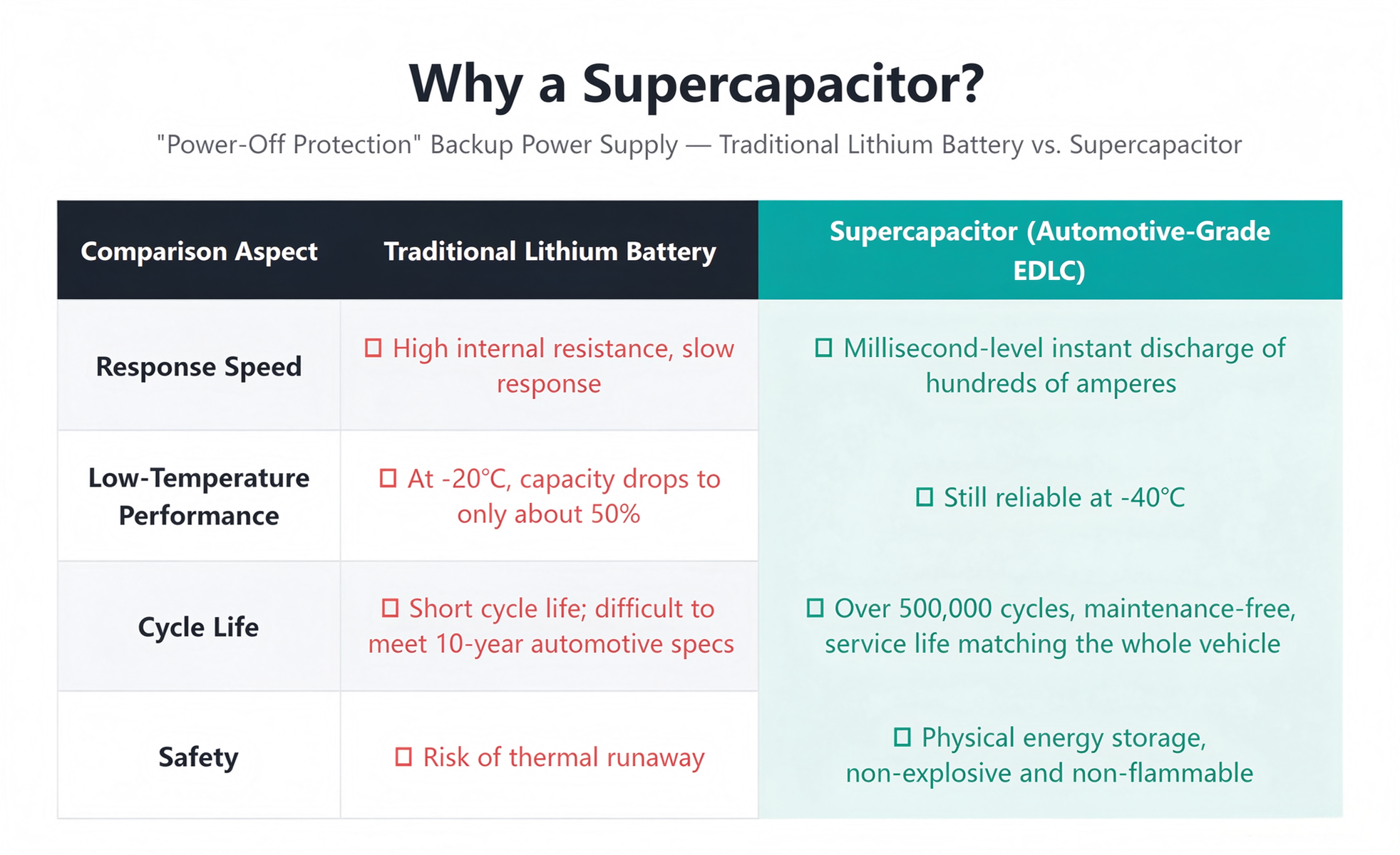
The door-lock motor requires an instantaneous discharge of several amperes within milliseconds. Furthermore, the system must remain capable of unlocking the vehicle even in extreme cold—down to -40°C—while also ensuring a 10-year service life (matching the vehicle's lifespan) and posing no risk of explosion. Conventional batteries suffer from high internal resistance and slow response times; at -20°C, they retain only about half of their capacity and pose a risk of thermal runaway. In contrast, supercapacitors offer millisecond-level response, reliable performance across a wide temperature range, and maintenance-free operation. Furthermore, because they store energy physically rather than chemically, there is no risk of explosion—making them the ideal choice for "power-loss protection."
A Ready-Made Solution for "Power-Loss Protection"
Building on the requirements mentioned above, Yongming’s automotive-grade electric double-layer supercapacitors are specifically designed for scenarios where operation must be maintained even during a power failure—such as the need to open a vehicle door.
Since power consumption and unlocking requirements vary depending on the door motor, we offer three capacity tiers to choose from:
| Series | Rated Voltage | Capacitance | Dimensions (mm) |
| SDH | 2.7 V | 25 F | 16 × 25 |
| SDH | 2.7 V | 35 F | 16 × 30 |
| SDH | 2.7 V | 50 F | 18 × 40 |
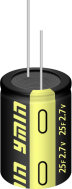
Figure 1 SDH 2.7V 25F 16×25
Higher capacity means more stored energy, allowing for flexible matching based on the power consumption and unlocking requirements of the door lock motor.
As for the "hard requirements" mentioned earlier, all three models meet them:
· Rapid Power Delivery: Capable of discharging high current within milliseconds, ensuring an immediate response when the door lock is triggered.
· Low-Temperature Resilience: Reliable even at -40°C—no performance failures during the winter.
· Long Lifespan: Rated for 500,000 cycles and maintenance-free, designed to last the entire service life of the vehicle.
· Enhanced Safety: Based on physical energy storage; non-explosive and non-flammable, ensuring it does not hinder escape efforts in the event of a fire.
Beyond vehicle doors, these solutions are applicable wherever operation is required following a power loss.
Supercapacitor-based emergency power supplies are not limited to vehicle doors—they are useful in any escape or rescue scenario where functionality must be maintained after a power failure:
· Post-Collision Door Unlocking: Provides power to door locks the instant a collision causes a power cut, ensuring doors can still be opened (Collision Power Module, or CPM).
· Emergency Window Operation: Allows windows to be lowered even after a power loss or if the vehicle is submerged, providing an additional escape route.
· Trunk Emergency Release: Offers a potential lifeline by allowing the trunk to be opened from the inside if a person becomes trapped.
Addressing the risks associated with "power-loss failure," the GB 48001-2026 standard now mandates "safety redundancy." The key to implementing this "power-loss protection" is the compact supercapacitor.
The Yongming (YMIN) SDH series (25F / 35F / 50F) offers ready-to-use solutions. We invite automotive OEMs and Tier 1 engineers to reach out for product selection guidance and samples.