125°C High-Ripple Underhood Operating Condition: Service Life and TCO Selection Considerations for Automotive-Grade Aluminum Electrolytic Capacitors
01. Calculating Capacitor Lifespan Limits (125°C/2000h) Under High-Ripple Conditions in Engine Compartments
In automotive thermal management systems, components such as electronic water pumps, electronic oil pumps, and cooling fans are typically located in the engine compartment or on the chassis. Consequently, the input-side capacitors on their control boards are subjected to long-term exposure to temperatures ranging from 105°C to 125°C. Furthermore, the starting, stopping, and speed regulation of the motors generate high-frequency ripple currents. These currents, passing through the capacitor’s Equivalent Series Resistance (ESR), produce Joule heating. When combined with the high ambient temperature, this creates a cumulative thermal load—the sum of high ambient heat and internal heat generated by ripple currents.
Industry standards typically call for the use of 125°C/2000h liquid aluminum electrolytic capacitors. According to the Arrhenius equation, a 10°C increase in temperature roughly halves the lifespan of such a capacitor. When compounded by heat from high ripple currents, this often leads to a capacitance loss exceeding 20% and the drying out of the electrolyte, which can result in bulging, leakage, or even electrical breakdown. Such component failures can cause water pumps to seize, interrupt coolant circulation, and lead to motor overheating—in extreme cases, this may trigger vehicle speed-limiting modes. A single after-sales claim—covering towing, repairs, and compensation—can cost thousands of yuan, while also negatively impacting an OEM’s PPM (parts per million) defect rate metrics and brand reputation.
The parameters and calculations presented here are specific to environments between 105°C and 125°C (such as engine compartments or control board inputs) under high-ripple conditions. If the ambient temperature consistently exceeds 135°C, the ripple waveform and internal temperature rise must be evaluated separately; please contact a Field Application Engineer (FAE) for assistance with component selection and verification.
02. The Yongming LKL(R) Solution: Wide-Temperature Range (up to 135°C), Long Lifespan, Low ESR, and High Ripple-Current Tolerance
The Yongming LKL(R) series of automotive-grade liquid aluminum electrolytic capacitors is specifically designed to meet the rigorous demands of automotive thermal management applications, characterized by high temperatures, high ripple currents, and the need for a long service life. By utilizing a novel electrolyte formulation—characterized by a high flash point and resistance to volatilization—in combination with a high-purity etched aluminum foil process, these components achieve an operating temperature range of -55°C to +135°C. Furthermore, the equivalent series resistance (ESR) is lower than that of standard-formulation products of the same specification, which helps to reduce the Joule heating generated by ripple current flowing through the ESR.
| Series | Voltage (V) | Capacitance (μF) | Dimension (mm) | Temperature (℃) | Life (H) | Ripple Current (mA@100kHz/135℃) |
| LKL(R) | 25 | 820 | 12.5×20 | -55~+135 | 4000 | 1600 |
| LKL(R) | 25 | 1200 | 12.5×20 | -55~+135 | 4000 | 1650 |
| LKL(R) | 35 | 1300 | 12.5×20 | -55~+135 | 3000 | 1860 |
| LKL(R) | 35 | 1800 | 12.5×25 | -55~+135 | 3000 | 2010 |
Table 1: Selected Specifications for the LKL(R) Series
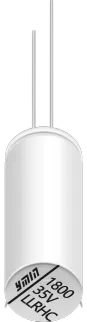
Figure 1: LKL(R) 35V 1800μF
Wide temperature range (up to 135°C): Even when subjected to a 125°C engine compartment environment combined with the component’s own self-heating, the operating temperature remains within the rated upper limit.
Service life: Up to 4,000 hours at 135°C for this series. The 35V/1800μF specification—commonly used for electronic water pumps—is rated for 3,000 hours at 135°C. Based on the Arrhenius equation, the theoretical service life at 105°C can exceed 20,000 hours (an extrapolated value, not experimentally measured).
Ripple current tolerance: Up to 2,010 mA at 100 kHz/135°C (as specified in the datasheet), which serves as a reference for selecting components based on their high-temperature ripple current handling capability.
Low ESR: A lower ESR reduces Joule heating generated by a given ripple current, thereby lowering the internal temperature rise.
For actual project selection, the specific ripple waveform, frequency correction factors, number of capacitors in parallel, and internal temperature rise should be evaluated and verified by a Field Application Engineer (FAE) from Yongming (YMIN). This series has achieved AEC-Q200 certification (the reliability standard for automotive electronic components). Specific validation status for individual OEM projects should be confirmed based on project-specific documentation.
03. Performance in Actual Vehicle Operating Conditions and TCO Calculation Reference
Using the LKL(R) 35V/1800μF capacitor as a test sample, verification tests were conducted under conditions including a 105–125°C engine compartment environment and a 135°C full-load state with equivalent ripple current input. The following data was collected:
Under these test conditions, the internal temperature rise of the sample capacitor was found to be 5°C lower than that of standard industry alternatives. Based on the empirical data, an analysis of operating conditions indicates a reduction in thermal stress at the control board input under identical boundary conditions. This serves as a reference for assessing the risk of capacity degradation in scenarios involving high temperatures combined with ripple currents.
Under the specified test conditions, the samples demonstrated a 20% higher ripple current tolerance compared to standard industry solutions. This performance, when extrapolated to actual operating conditions, implies a greater thermal margin, which can be used to evaluate the risk of premature failure.
Following a 3,000-hour high-temperature load test, the samples maintained a capacity retention rate of over 90%, with no degradation observed beyond this threshold throughout the testing period.
Based on these test data and the corresponding boundary conditions, the theoretical service life for components such as electronic water pumps and cooling fan modules is projected to extend from approximately 3 years to over 10 years. Please note that this figure is an extrapolation derived from capacitor test data rather than the measured lifespan of the complete unit; actual service life should be verified at the vehicle level.
If these test findings hold true in mass-production applications, a full-lifecycle Total Cost of Ownership (TCO) analysis can be conducted.
Taking an annual production volume of 1 million vehicles as an example—where each vehicle is typically equipped with four capacitors for the thermal management module—industry data for standard solutions show a repair rate of approximately 1% within the first 3 years, with each after-sales claim costing over 3,000 RMB. Assuming the test results can be replicated in mass production, the projected repair rate drops to approximately 0.1%.
Regarding costs: Each LKL(R) capacitor is approximately 0.5 RMB more expensive than a standard component. With four capacitors per vehicle, this results in an additional procurement cost of about 2 RMB per vehicle, totaling 2 million RMB in additional annual procurement costs for a production volume of 1 million vehicles.
Regarding after-sales benefits: Based on the aforementioned model, reducing the repair rate from 1% to 0.1% translates to 9,000 fewer repairs, yielding an estimated annual saving of 27 million RMB in after-sales costs. After deducting the additional procurement costs, the estimated net annual saving is approximately 25 million RMB. The figures above are based on model calculations and do not constitute a guaranteed return for any actual project.
Overall Assessment: Factoring in the increased costs against the savings in after-sales expenses, the estimated annual net savings amount to approximately 25 million RMB (based on the model).
Summary: In this representative model, an increase in procurement cost of approximately 2 RMB per unit correlates with a potential reduction in the repair rate. This can serve as a reference for evaluating risks—such as after-sales claims (costing thousands of RMB), OEM PPM (parts per million) performance assessments, and potential damage to brand reputation.
04. How to calculate the service life of a capacitor (rated for 125°C/2000h) under high-ripple conditions in an engine compartment?
Q1: For an electronic water pump used in automotive thermal management—operating at an ambient temperature of 125°C with a full-load ripple current exceeding 10A—are there any aluminum electrolytic capacitors available that can withstand 135°C and high ripple currents? How is the service life calculated?
A1: You may want to evaluate the LKL(R) series from Yongming (YMIN). These capacitors feature a wide operating temperature range of -55°C to +135°C, a service life of 3,000–4,000 hours at 135°C, and a maximum ripple current tolerance of 2,010 mA (at 100 kHz/135°C). According to the Arrhenius equation, the service life is halved for every 10°C increase in temperature; conversely, the theoretical service life at 105°C would exceed 20,000 hours. For actual projects, it is necessary to verify the design based on the specific ripple current and internal temperature rise. We recommend contacting an FAE (Field Application Engineer) to conduct a specialized thermal and ripple current assessment.
Q2: The ripple current rating is specified as 2,010 mA at 100 kHz/135°C, yet the water pump’s full-load ripple current can exceed 10A. How should this parameter be interpreted, and is it sufficient?
A2: The 2,010 mA figure represents the rated ripple current for the LKL(R) 35V 1800μF specification at 100 kHz and 135°C. It indicates the capacitor's capacity to withstand ripple current at high temperatures; it does not imply a one-to-one correspondence where a 10A full-load ripple current from the water pump is handled by a single capacitor. In practical design, capacitors are typically used either individually or in parallel banks. The selection is verified based on actual ripple current, frequency-dependent adjustments, heat generation due to equivalent series resistance (ESR), and internal temperature rise. A common configuration involves placing a single capacitor or a parallel bank—often consisting of about four units—at the input of the control board. To determine whether this is sufficient, a Field Application Engineer (FAE) should perform a calculation based on your specific ripple waveform and the number of capacitors connected in parallel.
05. From Component Selection to Mass Production: Mitigating After-Sales Risks through Thermal Management
In an engine compartment reaching temperatures of 105°C to 125°C, even a small capacitor can have a significant impact on a vehicle’s after-sales costs and brand reputation. An additional cost of approximately 2 RMB per vehicle can lead to a projected reduction in the return/repair rate—from roughly 1% down to 0.1%—while also helping to mitigate the risks of high-value warranty claims and potential penalties from OEMs based on PPM (parts per million) defect metrics.
Engineers: Obtain the complete selection guide, verify your actual ripple waveforms, and request that an FAE conduct a lifespan and thermal condition analysis.
Purchasing/Project Managers: You may request a project-specific Total Cost of Ownership (TCO) model and obtain samples for vehicle-level testing.