
How to Choose Capacitors for Robotic Joint Motors? LKZ Liquid Aluminum Capacitor Solution for Space-Constrained and High-Peak-Current Scenarios
Robot joint motor controllers are evolving toward higher integration, superior real-time performance, and greater intelligence. Consequently, capacitor selection is no longer just a matter of whether the capacitance value is sufficient; it now requires striking a balance between performance, physical layout, and weight reduction. In the power input stages, board-level power distribution, and filtering circuits of these controllers—where high-speed, high-load operation often demands significant instantaneous current—capacitors must simultaneously offer high energy storage capacity, low ESR, high ripple current tolerance, and resistance to vibration.
01 Assessing Temperature Rise, Noise, and Power Supply Response When Total Capacitance and Current-Carrying Capacity Are Insufficient
In applications such as robot joint motor controllers, it is common to use multiple MLCCs (Multi-Layer Ceramic Capacitors) in parallel for board-level filtering and transient energy storage. While paralleling multiple units increases the nominal capacitance, the limited capacity of individual MLCCs often results in a relatively low total capacitance.
In scenarios characterized by space constraints, high instantaneous currents, and high-frequency dynamic loads, an inadequate total capacitance or insufficient current-carrying capacity necessitates a thorough evaluation of temperature rise, operational noise, power supply response speed, and control precision. Failure to address these factors can lead to issues such as thermal derating, increased noise, sluggish power supply response, compromised control accuracy, and a higher risk of equipment failure or downtime.
Although MLCCs are widely used, they face inherent limitations in terms of material and manufacturing processes, resulting in low individual capacitance—a significant drawback when dealing with the space constraints and high instantaneous current demands typical of joint motor controllers. When multiple MLCCs are used in parallel, their combined total capacitance and current-carrying capacity must be carefully calculated based on the specific design. The core challenge in component selection lies in managing these tight space constraints while accommodating high instantaneous currents and maintaining sufficient design redundancy.
02 Product and Selection: LKZ 100V Series Liquid Aluminum Electrolytic Capacitors
In robot joint motor controller designs, a common existing approach involves using multiple low-capacitance MLCCs in parallel for board-level filtering and transient energy storage. This article uses a configuration of 48 parallel 100V 10μF MLCCs (in 1210 package size) as a reference example to illustrate component selection and calculation methodologies (this setup is provided solely for demonstration purposes and does not represent an actual customer application).
To address the requirements of this reference configuration—specifically regarding space constraints, high transient currents, and high-frequency dynamic loads—the LKZ series of liquid aluminum electrolytic capacitors from Yongming (YMIN) utilizes high-density materials and anti-vibration construction. These capacitors offer excellent vibration resistance, high ripple current tolerance, low ESR, and a wide operating temperature range. As a liquid aluminum electrolytic capacitor, each LKZ unit provides a nominal capacitance of 100V 150μF and a typical ripple current rating of 900mA (per the datasheet). Consequently, a parallel array of just four LKZ capacitors achieves a total nominal capacitance of 600μF, thereby reducing the number of components required and easing PCB layout constraints.
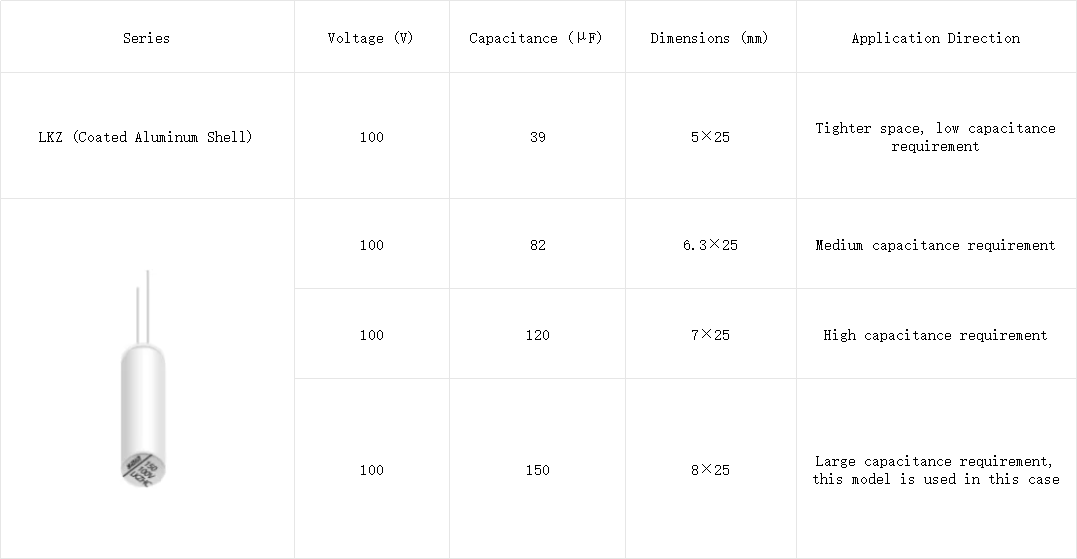
Table 1: LKZ 100V Recommendation Table
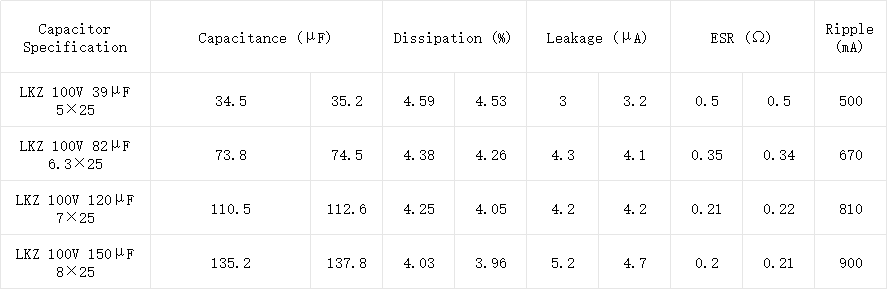
Table 2: LKZ 100V Test Data for Different Specifications
Note: Specific parameters should be verified against the relevant datasheets and actual test results. Final component selection must be determined based on the Bill of Materials (BOM), operating conditions, and empirical testing of the complete system.
03 Example Calculation: 48-MLCC Configuration vs. 4-LKZ (Parallel) Configuration
For this comparison, the baseline configuration consists of 48 MLCCs (100V, 10μF, 1210 package) in parallel. The alternative LKZ configuration is evaluated using 4 units (100V, 150μF, 8×25 dimensions) in parallel, providing a nominal total capacitance of 600μF. Based on the example BOM and mechanical structure, the following changes and evaluation criteria apply:
Component Count: Reduced from 48 to 4 units; impacts material management and PCB layout complexity.
Nominal Total Capacitance: Increased from 480μF to 600μF (+120μF, an increase of approximately 25%); affects board-level filtering and transient energy storage.
Current-Carrying Capacity: Expected to improve, based on nominal capacitance and rated ripple current specifications (exact ratios should be calculated using datasheets and actual test data).
Space Utilization: Approximately 20% space savings (based on the example project structure); impacts physical layout and assembly.
Overall Cost: Estimated reduction of over 60% (accounting for component count, layout space, and assembly management; excludes system-level validation costs); relates to total BOM cost.
Supply Chain: Utilizes domestic manufacturing processes and materials, enhancing delivery stability and supply chain autonomy.
The figures above are based on an example project. Since BOMs, operating conditions, and mechanical structures vary by project, final selection must be verified through actual testing.
Key Considerations for Capacitor Selection in Joint Motors
1. Calculate Total Capacitance: Do not focus solely on the capacitance of individual components; evaluate the transient energy supply based on the total capacitance when connected in parallel.
2. Consider ESR and Ripple Current: Low ESR helps reduce heat generation and ripple voltage drop, while high ripple current tolerance is essential for handling high-frequency dynamic loads.
3. Evaluate Spatial Layout: In space-constrained designs, prioritize solutions that offer high capacitance in a compact form factor to minimize component count and layout complexity.
4. Account for Vibration and Temperature: Since joint motors operate under conditions involving vibration and a wide temperature range, ensure that selected components are capable of withstanding these environments.
5. Assess Total Cost: Factor in the total component count, required layout space, assembly management, and supply chain stability.
6. Review the Supply Chain: For projects requiring stable delivery and supply chain autonomy, consider solutions utilizing domestically sourced materials and manufacturing processes.
In applications such as robotic joint motors—characterized by limited space, high transient currents, and high-frequency dynamic loads—the LKZ series of liquid aluminum electrolytic capacitors from Yongming (YMIN) may serve as a viable alternative to using multiple MLCCs. Suitability should be determined by analyzing the Bill of Materials (BOM), specific operating conditions, and empirical testing of the complete system.
If you would like to validate this solution, please contact us to request free samples and a demo board for testing, allowing you to verify your design with real-world performance data.