Compact Robot/Drone ESC Boards: Selection Parameters and Typical Applications of LKZ Pencil-Type, Film-Coated Aluminum-Case Capacitors
As electronic speed controller (ESC) boards for robots and drones become increasingly compact, capacitor selection is typically governed by four key constraints: high capacitance, small footprint, high ripple current tolerance, and high-temperature resistance. In scenarios where height is limited, designers using conventional cylindrical capacitors often face difficult trade-offs—balancing capacitance against volume, ripple current tolerance against temperature rise, and high-temperature resistance against operational lifespan.
Based on typical application data (assuming an annual shipment volume of 100,000 units, with after-sales costs covering repairs and logistics), some ESC applications experience an after-sales return/repair rate of approximately 5%–8%, translating to annual repair and logistics costs of roughly 2 million RMB. Furthermore, system failures or crashes caused by high-temperature issues can severely damage a brand's reputation.
What are the limitations of conventional cylindrical capacitors in ESC applications?
Standard cylindrical capacitors face inherent limitations in ESC environments. Their conventional structure is poorly suited for height-constrained spaces, making it difficult to achieve a high-capacitance, small-footprint design. Conversely, opting for smaller, lower-capacitance components may leave the capacitor unable to withstand the inrush currents generated during motor startup, leading to bulging and eventual failure.
Additionally, the limited surface area of standard aluminum casings, combined with relatively high Equivalent Series Resistance (ESR), causes significant Joule heating under high ripple current conditions. This accelerates the evaporation of the electrolyte, leading to an exponential decline in the capacitor's lifespan.
The issue is not that conventional capacitors lack performance, but rather that ESC applications impose exceptionally rigorous requirements: minimal space, high capacitance, high ripple current tolerance, and high-temperature resilience—a combination that is difficult to achieve with standard designs.
Technical Solution: Pen-style Structure + Low ESR + Coated-film Heat Dissipation
The LKZ series of "pen-style" coated-film aluminum electrolytic capacitors from Yongming (YMIN) are engineered with a focus on three core aspects: structure, materials, and heat dissipation. The key technical parameters and the corresponding value they deliver to customers are outlined below.
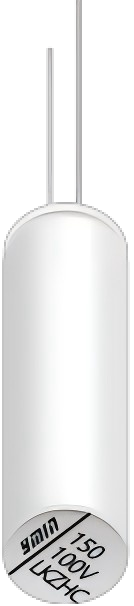
Figure 1: LKZ 100V 150μF
Structure: Coated-aluminum-casing, pen-style design. By utilizing a coated-aluminum-casing process—which ensures both voltage resistance and hermetic sealing—the internal winding density is optimized. This results in a component that is over 30% smaller in volume and 20% shorter in height than standard capacitors of the same capacity. For height-constrained electronic speed controller (ESC) boards, this frees up valuable space for power components and thermal management designs.
Materials: Low ESR, reducing heat generation at the source. The use of high-conductivity electrolyte and low-ESR separator paper significantly lowers the Equivalent Series Resistance (ESR). Taking the LKZ 100V 150μF (8×25mm) model as an example—based on Yongming’s specifications and internal test data—the ESR is as low as approximately 0.20Ω at 100kHz, which helps minimize Joule heating at the source.
Thermal Management: Coated aluminum casing combined with low ESR leads to lower temperature rise. The coated-aluminum-casing design enhances surface heat dissipation efficiency; when paired with low-ESR characteristics, it reduces the capacitor's temperature rise by 15–20°C under the same ripple current. Furthermore, the rated ripple current capacity at 105°C is increased by 50%.
ESC Module Testing: Simultaneous Improvement Across Four Key Metrics
In tests conducted on an electronic speed controller (ESC) module, replacing existing components with the Yongming LKZ series resulted in simultaneous improvements across four key metrics:
l Volume reduced by over 30%, with a 20% reduction in height (for the same capacity);
l Ripple current capacity at 105°C increased by 50%;
l Temperature rise reduced by 18°C under the same ripple current;
l Service life extended by more than 2 times.
Measured Specifications:
Test Data for the LKZ Series
The following data represents test results for selected specifications within the LKZ series, provided for reference during component selection and replacement evaluation.
| Capacitor Spec | Capacitance (μF) | Dissipation Factor (%) @120Hz | Leakage Current (μA) | ESR (Ω) @100kHz | Ripple Current (mA/RMS) @100kHz / 105℃ | ||||
| LKZ 100V 39μF 5*25 | 34.5 | 35.2 | 4.59 | 4.53 | 3 | 3.2 | 0.5 | 0.5 | 500 |
| LKZ 100V 82μF 6.3*25 | 73.8 | 74.5 | 4.38 | 4.26 | 4.1 | 4.1 | 0.35 | 0.34 | 670 |
| LKZ 100V 120μF 7*25 | 110.5 | 112.6 | 4.25 | 4.05 | 4.2 | 4.2 | 0.21 | 0.22 | 810 |
| LKZ 100V 150μF 8*25 | 135.2 | 137.8 | 4.03 | 3.96 | 4.7 | 4.7 | 0.2 | 0.21 | 900 |
Impact on the Complete Unit and After-Sales Returns
At the level of the complete unit, the PCB layout becomes more flexible, and the overall power density is increased. The risk of system crashes under high-temperature or high-load conditions is reduced, as is the likelihood of capacitor bulging or failure. Consequently, the after-sales return/repair rate drops from 5% to below 0.5%.
Taking an electronic speed controller (ESC) manufacturer with an annual shipment volume of 100,000 units as an example:
| Comparison Item | Conventional Capacitor Solution | LKZ |
| Unit Price of Capacitor | Approx. ¥0.5 lower per piece | Approx. ¥0.5 higher per piece |
| After-sales Repair Rate | 0.05 | Below 0.5% |
| After-sales Cost for 100k Units Shipped Annually | High | Save approx. ¥2 million per year |
| Capacitor Service Life | Standard | More than 2x longer, reducing full-lifecycle maintenance cost |
Incremental ROI:
Taking an additional cost of approximately 0.5 yuan per unit as an example—which helps mitigate after-sales risks valued at about 20 yuan per unit—the return on investment (ROI) ratio is approximately 1:40. An extra expenditure of roughly 0.5 yuan per unit is invested to reduce the risks of high-temperature system crashes, catastrophic hardware failures, and the need for after-sales repairs.
Summary:
Why Consider the LKZ Series for Electronic Speed Controller (ESC) Projects?
The LKZ series—a line of "pen-style" (cylindrical/slim-profile) film-coated aluminum electrolytic capacitors—is designed for applications that demand increasingly high power density, such as robotics, drones, the low-altitude economy, and industrial automation. The LKZ series is also an ideal solution for sectors including automotive electronics, charging infrastructure, servers, smart home devices, telecommunications equipment, and industrial control—anywhere engineers face the common capacitor selection challenges of limited space, high ripple current, excessive temperature rise, and short service life.
Its core value lies in combining a "pen-style" structure with low ESR and a heat-dissipating film coating. This unique design resolves the inherent trade-offs between high capacitance, compact size, high ripple current tolerance, and high-temperature resistance:
l Compact Size, High Capacitance: Reduces volume by over 30% and height by 20% for the same capacitance value.
l High Ripple Current Tolerance, Low ESR: Increases ripple current capacity by 50% at 105°C, with an ESR as low as ~0.20Ω at 100kHz.
l High-Temperature Resistance, Long Lifespan: Lowers temperature rise by 18°C under identical ripple current conditions and more than doubles the service life.
l Clear Commercial Value: Reduces the post-sales return/repair rate from 5% to below 0.5%, resulting in annual savings of approximately 2 million RMB, with a return on investment (ROI) ratio of about 1:40.
If you are currently selecting components for next-generation electronic speed controllers (ESCs) or compact power modules, please contact Yongming (永铭) to request the LKZ series datasheet, samples, and test data, or to receive expert product consultation and selection support.