YMIN IDC3 Series 475V High-Voltage Snap-in Aluminum Electrolytic Capacitors: A Verifiable Domestic Alternative for AI Server Power Supplies
Why PFC Bus Energy Storage in 1U Chassis Is Becoming Increasingly Challenging
As the power density of AI server power supplies continues to rise, designers are constrained by the mere ~44mm internal height of a 1U chassis. Components for PFC bus energy storage and the DC-Link stage must endure high-frequency, high-ripple currents, elevated internal temperatures, and fan-induced vibrations—all while supporting 24/7 continuous operation. Traditional snap-in (lug-type) capacitors are often too bulky; they crowd the PCB, obstructing routing space and blocking critical airflow paths. Furthermore, their relatively high Equivalent Series Resistance (ESR) leads to significant Joule heating when subjected to large ripple currents. This temperature rise accelerates component degradation and shortens service life. Inadequate ripple current handling can also cause fluctuations in the bus voltage, destabilizing the power supply to the GPU. Should a capacitor fail, the resulting costs—ranging from service interruptions to warranty repairs—can be substantial.
The Challenge Goes Beyond High Voltage: Balancing Voltage, Capacitance, ESR, and Ripple Current Handling
There is an inherent trade-off between voltage rating and capacitance in aluminum electrolytic capacitors. Achieving high capacitance at a 475V rating while maintaining a compact form factor requires high-specific-capacitance anode foil and advanced winding processes. ESR is not determined by a single factor; it is a function of electrolyte conductivity, the resistance of the separator paper, and the contact resistance between the electrode foil and the terminals. Traditional manufacturing processes often result in higher contact resistance, making it difficult to drive ESR lower. In terms of electrical parameters, the true bottleneck lies in achieving the right balance between voltage margin, ESR, and ripple current capacity. Under high-frequency operating conditions, the Joule heat generated by ripple current flowing through the ESR is the primary driver of temperature rise; if the ESR is too high, the capacitor will overheat and fail prematurely. Consequently, the solution is not as simple as swapping in a capacitor with a higher voltage rating. Instead, the requirement is for a component that strikes an optimal balance between high voltage, high capacitance, a compact footprint, low ESR, and high ripple current tolerance.
Yongming IDC3 Series: 475V High-Voltage Snap-in Capacitors Engineered for PFC Bus Energy Storage
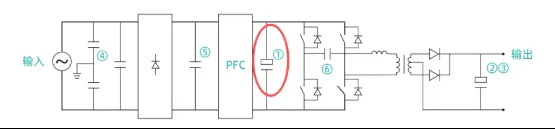
Figure 1: Typical topology of an AI server power supply; the red circle (①) indicates the PFC bus energy-storage capacitor.
(Application position for the Yongming IDC3 series)
In the topology of an AI server power supply, the PFC bus energy-storage capacitor is more than just a passive component—it serves as a critical line of defense for maintaining continuous computing power output. It performs two core functions:
1. High-frequency filtering and voltage stabilization to prevent accidental power supply shutdowns
The capacitor effectively suppresses ripple voltage generated by the high-frequency switching of GaN/SiC power devices, stabilizing the bus potential. Even when a GPU draws a large current under a sudden full-load state, the capacitor prevents voltage drops or power supply trips, ensuring a stable and continuous output of computing power. The ultra-low ESR (Equivalent Series Resistance) of the IDC3 series is specifically designed to minimize internal heat generation under these high-frequency operating conditions, ensuring optimal filtering performance.
2. Short-term energy buffering to maintain operations during power grid fluctuations
In extreme scenarios—such as brief power grid interruptions or sudden spikes in computing load—the capacitor instantly releases stored energy to act as a buffer. This prevents the server from losing power, ensuring that operations and computing tasks remain uninterrupted and significantly reducing the risk of failures in the data center. The high-voltage, high-capacitance, and high-ripple-current tolerance of the IDC3 series provide a robust "energy reservoir" for this buffering process.
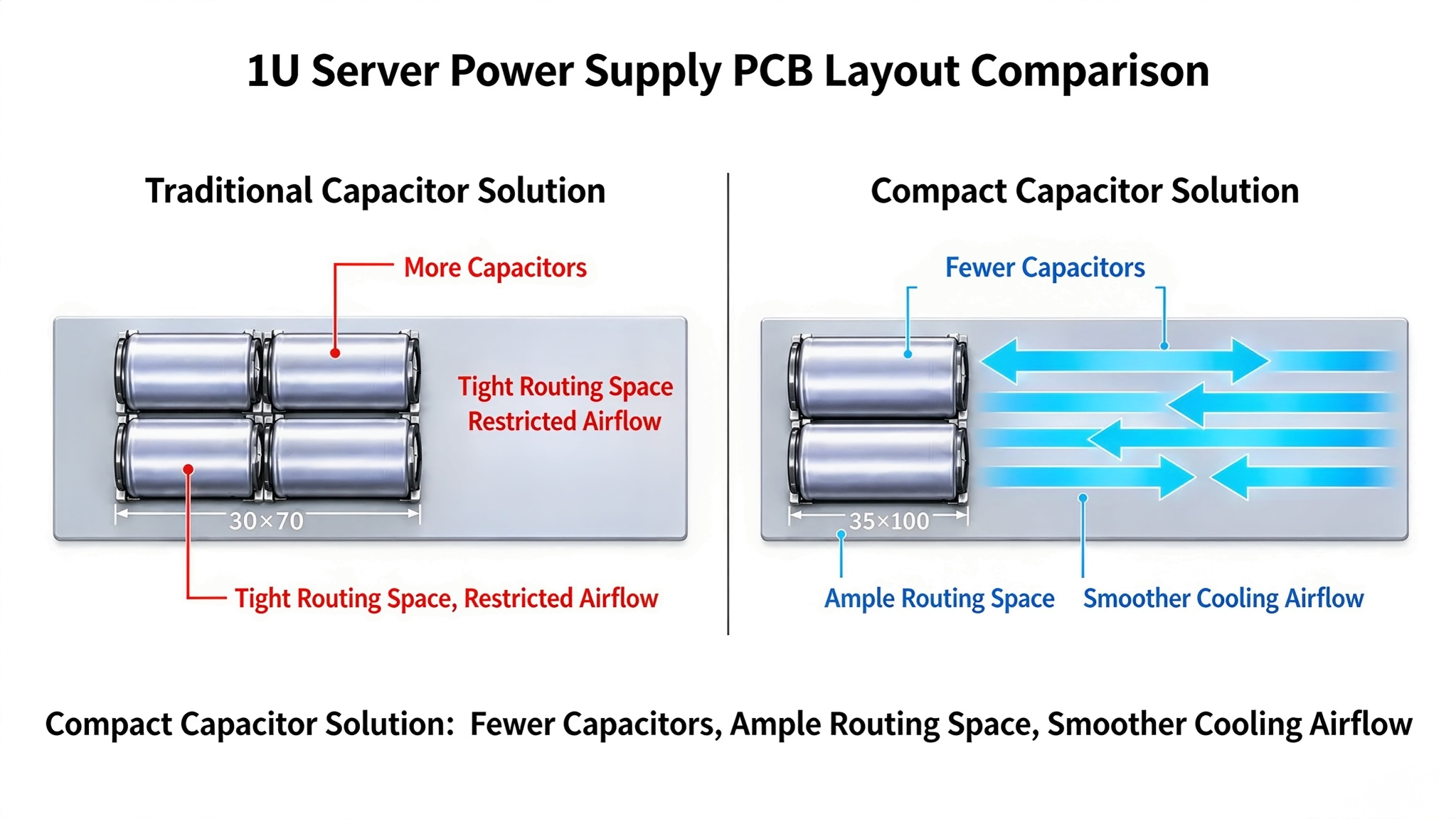
Figure 2: Comparison of PCB Layouts for 1U Server Power Supplies
Yongming is one of the few domestic Chinese manufacturers of aluminum electrolytic capacitors with full-chain production capabilities—from electrode foil to finished products—for high-voltage (475V), high-capacitance snap-in capacitors. The IDC3 series is specifically designed for PFC DC-bus energy storage in AI server power supplies. It is currently in the sampling and verification phase, and the company is ready to support clients with comprehensive technical evaluations and testing.
Key Parameters and Design Highlights:
Voltage and Capacitance: 475V; capacitance ranges from 1670μF to 2700μF (with the full series covering various specifications from 1300μF to 2970μF).
Ripple Current Tolerance: Up to 4.48A at 120Hz (up to 4620mA at 100kHz).
Low ESR and Reduced Heat Generation: Manufactured using a specialized process that significantly lowers ESR, minimizes heat generation under high ripple currents, and enhances the capacitor's rated ripple current capacity.
Large-Format Dimensions: Capable of stable production in 30/35×140mm dimensions (140mm in height), meeting requirements for high capacitance and high power.
High-Temperature Durability, Long Lifespan, and Vibration Resistance: Rated for 3,000 hours at 105°C; features high resistance to vibration and aging, making it suitable for high-reliability applications.
[Recommended IDC3 475V Specifications – Visit the Yongming official website for more information.]
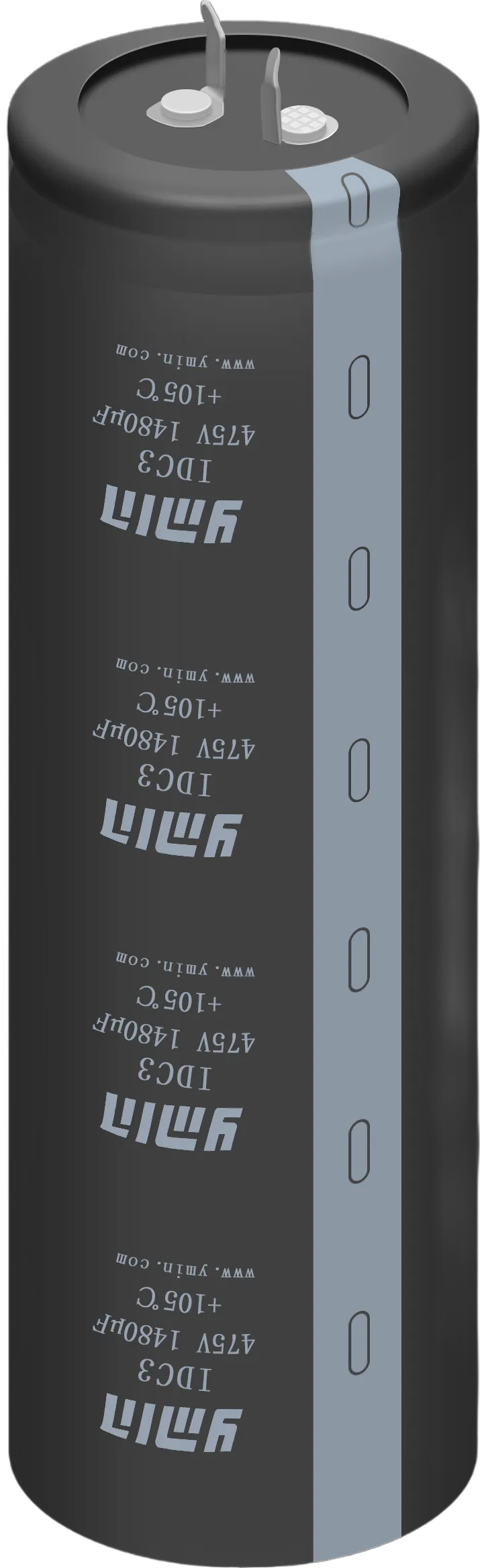
| Series | Operating Temperature (°C) | Rated Life (H) | Rated Voltage (V) | Capacitance (μF) | Dimension (mm) | Ripple Current (mA) |
| IDC3 | -40~105 | 3000 | 475 | 1300 | 30*80 | 3120 |
| IDC3 | -40~105 | 3000 | 475 | 1670 | 30*100 | 3910 |
| IDC3 | -40~105 | 3000 | 475 | 2000 | 30*120 | 4070 |
| IDC3 | -40~105 | 3000 | 475 | 2200 | 30*140 | 4250 |
| IDC3 | -40~105 | 3000 | 475 | 1770 | 35*80 | 3650 |
| IDC3 | -40~105 | 3000 | 475 | 2270 | 35*100 | 4290 |
| IDC3 | -40~105 | 3000 | 475 | 2700 | 35*120 | 4485 |
| IDC3 | -40~105 | 3000 | 475 | 2970 | 35*140 | 4620 |
Figure 3: Selection Recommendations for Yongming IDC3 Series 475V Capacitors
For engineers, the IDC3 series means lower temperature rise; for clients, it translates to cost savings.
During project validation, the IDC3 series 475V capacitors demonstrated significant improvements: under identical operating conditions, the Equivalent Series Resistance (ESR) is notably lower than that of conventional solutions (refer to the datasheet for typical values), with a ripple current handling capacity of up to 4.48A (at 120Hz). Furthermore, the capacitor’s temperature rise is expected to decrease by 15–20°C under the same operating conditions. With a rated lifespan of 3,000 hours at 105°C, these capacitors are well-suited for the 24/7 continuous operation requirements of AI servers.
From a commercial perspective, these technical enhancements offer tangible business value: the pin-to-pin compatible design and comprehensive technical specifications can shorten the selection and validation cycle for power modules by approximately 1–2 months. A domestic supply chain ensures a stable lead time of 4–6 weeks—significantly reducing the risk of supply disruptions compared to Japanese alternatives. Moreover, the ultra-low ESR and reduced heat generation help mitigate the risks of post-sales repairs and system downtime. For engineers, this means better thermal performance and longer service life; for procurement teams and management, it translates to optimized development cycles, reliable lead times, and lower after-sales costs.
Evaluating the "higher price" through the lens of TCO (Total Cost of Ownership)
While the unit price of the Yongming IDC3 series 475V capacitors is 15%–25% higher than that of standard domestic snap-in capacitors (yet still 20%–30% more cost-effective than Japanese brands), this premium is justified by quantifiable performance gains. The ultra-low ESR and low heat generation—achieved through specialized manufacturing processes—along with high power density resulting from compact, space-optimized dimensions, collectively reduce after-sales risks, shorten development timelines, and enhance supply chain security.
To be objective: while Yongming capacitors may not be the cheapest option on the market, their superior performance helps prevent equipment returns caused by component failures, thereby significantly lowering the overall cost for the client. The initial premium is offset by lower operating temperatures, an extended service life, more stable lead times, and a reduction in the need for repairs.
Conclusion
The Yongming IDC3 series 475V high-voltage snap-in capacitors offer a domestic alternative for PFC bus energy storage in AI server power supplies, with samples available for validation. Their value extends beyond merely meeting technical specifications; they also help shorten the selection and validation cycle, ensure stable lead times, and reduce the risks of post-sales repairs and system downtime.
For further evaluation, please contact Yongming to obtain the IDC3 series 475V datasheet, test reports, and selection guide, or to request samples for validation. We are also available to assist with technical assessments and testing for your PFC bus energy storage applications.